Training
How to Start Working Out at Home as a Beginner (A Woman's Guide)
By the Reshape 30 Team··7 min read

A calm, step-by-step plan for starting home workouts from zero: what to do in your first two weeks, how hard to push, and how to avoid the most common beginner mistakes.
Start smaller than you think you should
The most common reason beginners stop working out is not a lack of willpower. It is starting too big. Doing an intense hour on day one often leads to soreness so strong you dread the next session, and then life gets busy and the habit never forms.
A better approach is to start with workouts that feel almost too easy. Fifteen to twenty minutes, three times a week, with moves you can do with good form. Your first goal is not to transform your body in a week. It is to become someone who works out regularly. Results follow that identity, not the other way around.
Set up a simple home workout space
You do not need a home gym. You need a spot where you can lie down and take a step in each direction, and ideally a place where you can leave a mat rolled out as a visual reminder. Clear the area of anything you could trip over.
Helpful but optional: a yoga mat or thick towel, a sturdy chair or couch for supported moves, a water bottle, and a way to time intervals. Later on, you might add resistance bands or dumbbells, but bodyweight is plenty to get started and to keep progressing for months.
- A mat-sized area of clear floor
- A sturdy chair, couch, or wall for support
- A timer or workout app
- Comfortable clothes and supportive shoes (or bare feet on a non-slip surface)
Learn five foundational movements
Almost every effective strength workout is built from a handful of basic movement patterns. If you learn these well, you can follow nearly any beginner program safely. Practice each one slowly before adding speed or volume.
Spend your first few sessions treating these moves like a skill. Watch yourself in a mirror or film a few reps on your phone. You are looking for controlled movement, a neutral spine, and knees that track in line with your toes.
- Squat: sit back and down, then stand tall (use a chair as a target at first)
- Hinge: push your hips back with a flat back, like closing a car door with your hips
- Push: incline push-ups against a wall or counter
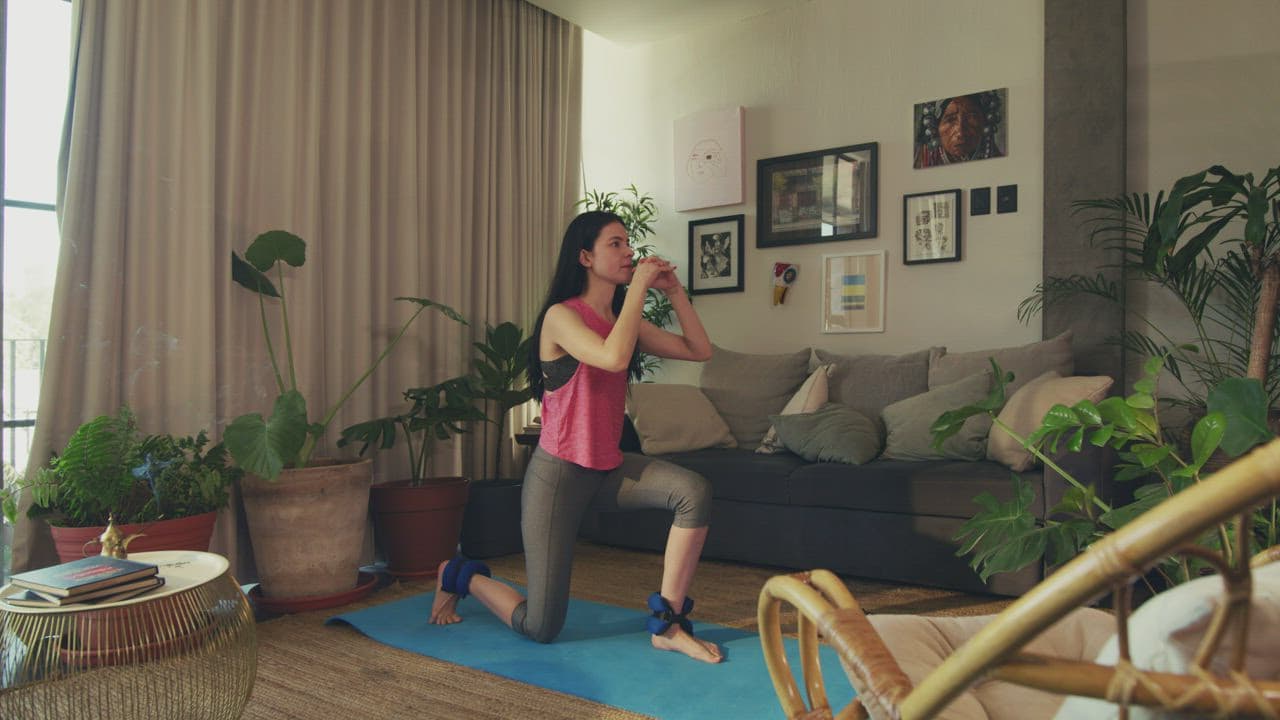
- Lunge or step: reverse lunges or step-backs, holding support if needed
- Core brace: dead bugs, bird dogs, or a plank on your knees
A simple first two weeks
Here is a gentle structure you can follow. Each workout day uses the five movements above. Do each move for 30 seconds, rest 30 seconds, and complete 2 rounds. Add a 3-minute warm-up of marching and arm circles, and a few minutes of stretching at the end.
In week two, keep the same moves but increase to 3 rounds, or change the timing to 40 seconds of work and 20 of rest. That small step is enough to keep you progressing without feeling overwhelmed.
- Week 1: Monday, Wednesday, Friday, 2 rounds at 30/30 timing
- Week 1 off days: a 15-20 minute walk or gentle stretching
- Week 2: same days, 3 rounds or 40/20 timing
- Week 2 off days: walk, stretch, or rest, whatever helps you feel good
How hard should a beginner workout feel?
A useful guide is the talk test. During the work intervals you should be breathing harder and feel your muscles working, but still be able to say a short sentence. If you cannot speak at all, ease off. If you could chat comfortably the whole time, you can push a little more.
Some muscle soreness a day or two after a new workout is normal, especially at first. It usually fades as your body adapts. Sharp pain, joint pain, dizziness, or chest discomfort are different: stop and get checked by a healthcare professional. It is also wise to talk with your doctor before starting if you have a medical condition, are pregnant, or have been inactive for a long time.
Make it stick: beginner habits that matter more than the workout
Schedule your workouts like appointments. Pick specific days and times and put them in your calendar. When the time comes, the decision is already made.
Track something simple, such as a checkmark on a calendar for every workout completed. Seeing a chain of checkmarks is surprisingly motivating. And if you miss a day, just do the next scheduled workout. One missed session does not undo anything; quitting is the only thing that does.
- Put workouts on your calendar at a set time
- Lay out clothes or your mat the night before
- Track completed sessions, not just results
- Never miss twice in a row, and never try to make up missed sessions by doubling up
Common beginner mistakes to avoid
Comparing yourself to others is one of the fastest ways to lose motivation. The woman in the video may have years of training behind her. Your only fair comparison is you from last week.
Another frequent mistake is skipping the warm-up and cool-down to save time. They only take a few minutes, and they help your body ease into and out of the work. Finally, resist the urge to change programs every few days. Sticking with one simple plan for several weeks lets you see whether it is working and gives your body time to adapt.
- Doing too much, too soon
- Rushing reps instead of controlling them
- Skipping warm-ups and cool-downs
- Program-hopping before giving a plan a fair chance
This article is for general educational purposes and isn't medical advice. Talk to your healthcare provider before starting a new exercise or nutrition program.