Training
A 20-Minute At-Home Workout for Women (No Equipment Needed)
By the Reshape 30 Team··7 min read

A complete, follow-along 20-minute full-body workout you can do in your living room with zero equipment, plus how to scale it up or down and how often to repeat it.
Why 20 minutes is enough to make real progress
If you have ever skipped a workout because you could not find a free hour, you are not alone. The good news is that a focused 20-minute session can absolutely build strength and fitness, especially when you are starting from little or no regular exercise. What matters most is not the length of any one workout, but how consistently you repeat it over weeks.
Short workouts also remove a lot of friction. There is no drive to the gym, no waiting for machines, and no need to pack a bag. You can do this routine before the kids wake up, during a lunch break, or while dinner is in the oven. When a workout is easy to start, you are far more likely to actually do it.
The routine below is built around a simple idea: work the big muscle groups (legs, glutes, back, chest, and core) in a circuit, keep the rest short, and finish feeling challenged but not wrecked. That way you can recover and come back for more in a day or two.
Before you start: space, timing, and effort
You need roughly the space of a yoga mat, plus a little room to step side to side. A mat or a folded towel makes floor moves more comfortable. Wear supportive shoes if you have them, or go barefoot on a non-slip surface.
This workout uses timed intervals rather than counting reps, so a phone timer or interval app works well. Aim for an effort level where you could still speak in short sentences, but would not want to hold a long conversation. On a 1-10 scale, think 6 or 7 out of 10.
- Format: 3 rounds of 6 exercises
- Timing: 40 seconds of work, 20 seconds of rest
- Rest between rounds: 60 seconds
- Total time: about 20 minutes including warm-up and cool-down
Warm-up (3 minutes)
A short warm-up raises your body temperature and gets your joints moving so the main circuit feels smoother. Do each move for about 30 seconds and move continuously from one to the next.
- March in place, swinging your arms
- Arm circles, forward then backward
- Hip circles, both directions
- Bodyweight good mornings (hinge at the hips with a flat back)
- Slow alternating reverse lunges
- Side steps with a gentle squat
The main circuit (15 minutes)
Complete each exercise for 40 seconds, rest 20 seconds, then move to the next. After all six, rest 60 seconds and repeat for 3 rounds total. Move with control: smooth, steady reps beat fast, sloppy ones every time.
Squat: Feet about hip-width, sit your hips back and down as if reaching for a chair, chest proud, then stand tall and squeeze your glutes at the top.
Incline or knee push-up: Hands on a sturdy couch, counter, or the floor with knees down. Lower your chest with elbows angled slightly back, then press away. Keep a straight line from head to knees or heels.
Glute bridge: Lie on your back, knees bent, feet flat. Press through your heels to lift your hips until your body forms a line from shoulders to knees. Pause, then lower slowly.
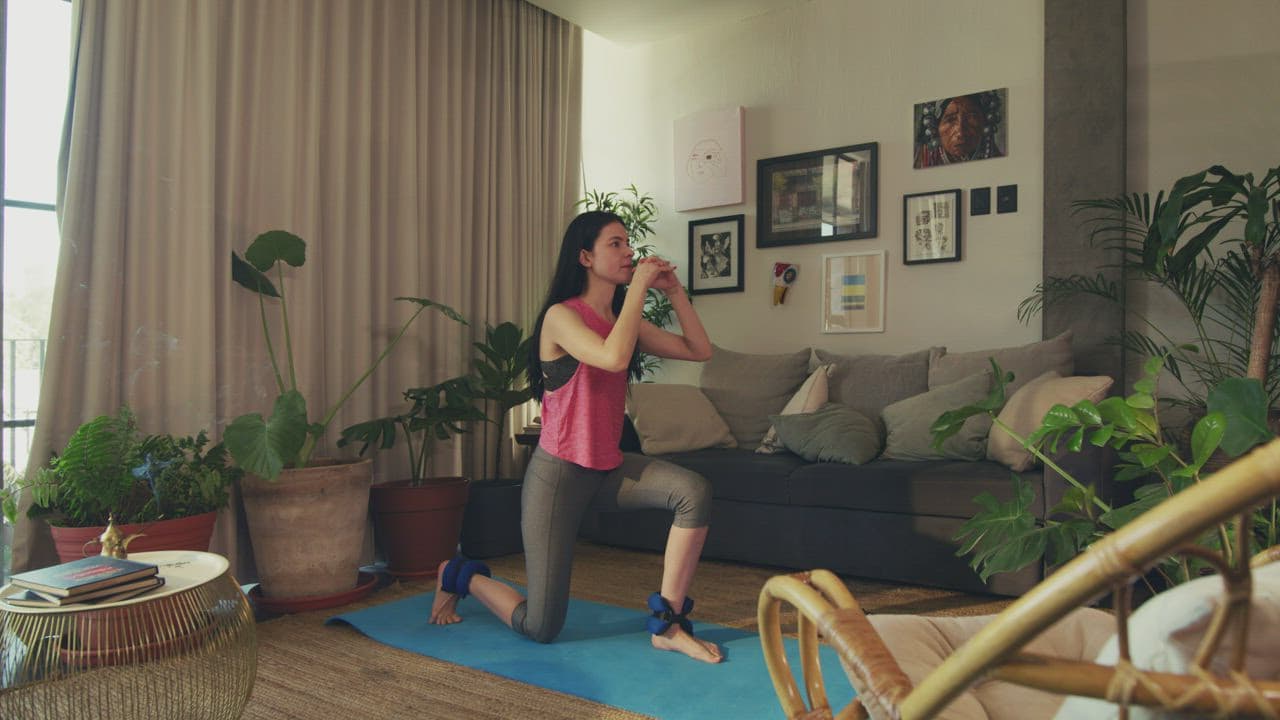
Alternating reverse lunge: Step one foot back and lower until both knees are bent, then drive through the front heel to return. Alternate sides. Hold a wall or chair for balance if needed.
Bird dog: On hands and knees, reach one arm forward and the opposite leg back, keeping your hips level. Return and switch sides. This trains your core and back without any strain on the neck.
Plank: Forearms or hands under shoulders, body in a straight line. Brace your belly as if you are about to laugh. Drop to your knees whenever your form starts to slip.
Cool-down (2 minutes) and how to scale it
Finish with gentle stretches held for about 20-30 seconds each: a standing quad stretch, a seated hamstring reach, child's pose, and a doorway chest stretch. Breathe slowly and let your heart rate settle.
To make the workout easier, do 2 rounds instead of 3, use 30 seconds of work with 30 seconds of rest, or choose the gentler version of each move (higher surface for push-ups, smaller lunge range, plank on knees). To make it harder, add a fourth round, slow down the lowering part of each rep to three seconds, or try single-leg glute bridges and split squats.
- Easier: 2 rounds, 30/30 timing, supported variations
- Standard: 3 rounds, 40/20 timing
- Harder: 4 rounds, slower tempo, single-leg progressions
How often should you do this workout?
Three sessions a week on non-consecutive days (for example Monday, Wednesday, Friday) is a realistic starting point for most women. On the days in between, a walk, light stretching, or simple rest helps your body recover.
After two or three weeks, the workout should start to feel more manageable. That is your cue to progress, either by adding a round or switching to a harder variation of one or two moves. Small, steady increases keep you improving without burning out. If you have a health condition, are pregnant or postpartum, or are returning from an injury, check in with your doctor or a qualified professional before starting a new routine.
This article is for general educational purposes and isn't medical advice. Talk to your healthcare provider before starting a new exercise or nutrition program.